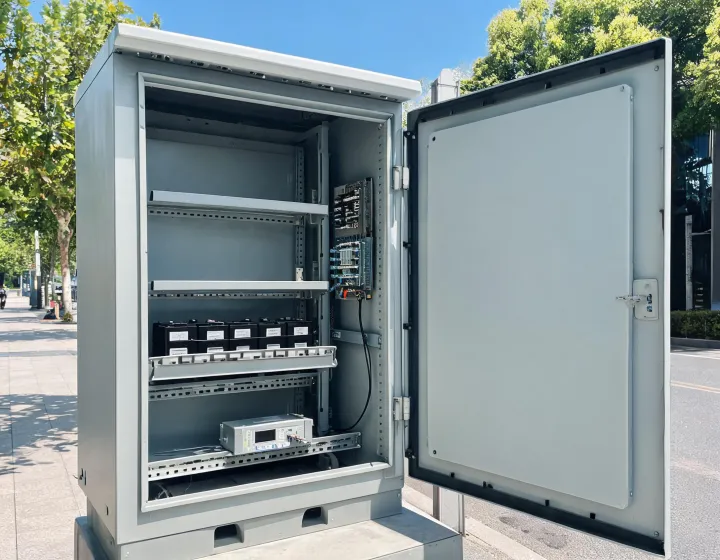
Translate the install into fields
Indoor cabinet
Record whether the feed is a DC plant or an AC branch, the continuous 12 V current, and the millimetres of free TS35 rail. A rack unit measurement describes a shelf, not a DIN module, unless the design truly uses both.
Ask if alarm wiring already exists. A dry contact that must close on loss of output is a line item. So is the side clearance the datasheet uses for cooling.
Outdoor enclosure
State ambient range, solar load and whether the enclosure, not the bare supply, carries the ingress protection rating. Derating at the high ambient belongs in the quote. Do not copy an indoor efficiency curve into an outdoor brief.
Name the destination and any crane or sidewalk limit. Those constraints sit beside freight. They are not evidence that a factory has stock.
Access node with powered loads
If the 12 V rail only feeds a radio and a separate switch provides Power over Ethernet, keep those budgets apart. Endpoint wattage, cable loss and optical budget are fiber or switch questions. They do not set the DIN-rail current by themselves.
Wavelength and insertion loss stay on the optical sheet. Mixing them into the power price makes both comparisons weaker.
Lab or staging bench
A bench may accept a wider ripple or a shorter lead. Write that tolerance down. If the buyer wants a measured output, ask for the test method and any calibration traceability the supplier can attach to that method.
Runtime belongs to batteries or a UPS when those are in the project. A DIN-rail rectifier hold-up, stated in milliseconds at a named load, is a different number. Do not label either figure as site autonomy.
Choices that should be explicit
New equipment can simplify support. Refurbished equipment can fit a discontinued footprint when condition, warranty and repeated tests are written. Put the condition in the RFQ so a 12 V price is not a blend of both.
An original maker and an alternate maker can both be asked to quote. The buyer preference for high-end, mid-range or budget-friendly sourcing is not a lab result. Compatibility with the existing alarm pair and terminal style still has to be checked on the exact model. Ask the quote to name output voltage, current limit, and the terminal style on that model.
Documents follow the model: datasheet, wiring sketch, derating plot and, when applicable, the safety file. For a 12 V, 5 A radio load, ask derating at 40 °C and at 50 °C, whether hold-up is 20 ms at 115 V, whether the rail is 35 mm, and whether a 48 V plant feed is converted before this rail. IEC 62368-1 stays a model file. A supplier quality-system certificate is optional context. It does not replace product evidence. Public infrastructure catalogs from other countries are useful only as attribute checklists.